Darkbloom opens public alpha for private AI inference on idle Macs
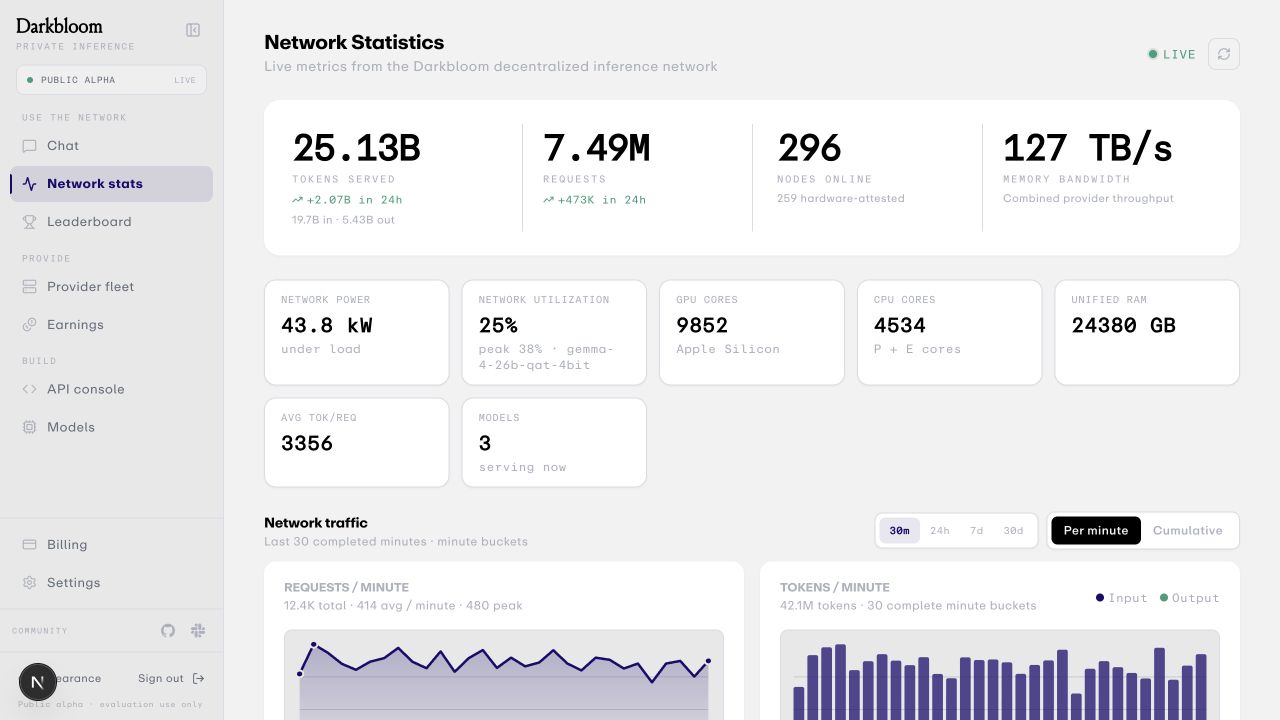
Darkbloom has opened a public alpha for a private-inference network that routes AI requests to idle Apple Silicon Macs. The project presents itself as a joint effort from Darkbloom and Eigen Labs. Its central promise is to use hardware that owners already have, while keeping the provider who runs the Mac from reading a customer's prompt or response. The launch page was last modified on August 27, 2026, according to the site's HTTP metadata, and labels the service a public alpha with expected rough edges and downtime.
For developers, Darkbloom offers an OpenAI-compatible API. The documented integration uses a familiar client and changes the base URL to api.darkbloom.dev. The site also lists Anthropic Messages compatibility, streaming responses and selected models such as Gemma 4 26B and GPT-OSS 20B. Its pricing page says listed rates target roughly half the price of comparable hosted APIs, while its live figures and model catalogue can change. Those are the project's own current claims, not an independent benchmark or price guarantee.
The privacy design has several parts. Requests are encrypted before transmission; the coordinator routes the ciphertext and re-encrypts a request for an attested provider. The provider runs inference in-process through MLX in a hardened macOS process. Darkbloom's technical documentation makes an important qualification: the coordinator decrypts requests briefly inside a hardware-encrypted Confidential VM for routing and billing. It says that plaintext is not logged or retained, but the system is therefore not a design in which no intermediary ever sees plaintext.
Hardware attestation is intended to link a provider to Apple security mechanisms, including Secure Enclave keys and Apple's Managed Device Attestation. The public alpha initially focuses on Apple Silicon Macs, with the landing page saying it is starting with machines that have at least 48 GB of memory. Providers keep 100 percent of inference revenue during the alpha, according to the site.
For AI users and makers, the announcement is notable because it combines local hardware, an established API shape and a stronger privacy goal than a conventional shared server. It is still an early service rather than a proven replacement for established cloud inference. Teams should test latency, model quality, availability, data handling and the provider trust signals before sending confidential workloads. The economic claims, security architecture and operator earnings also deserve independent testing as the network grows.