Loudoun Water puts data-center use at 29 million gallons on an average day
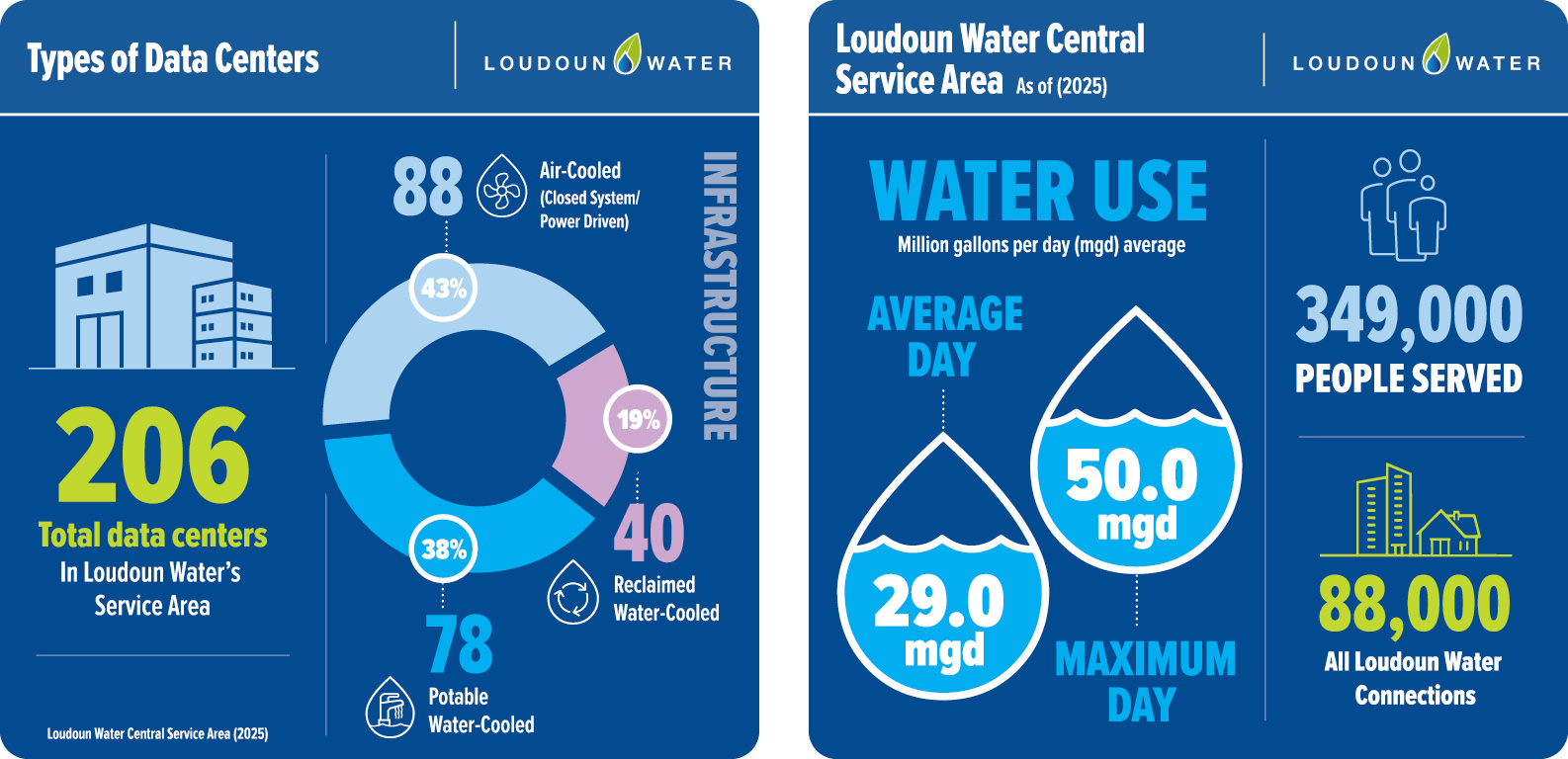
Loudoun Water has published a snapshot of how data centers fit into the utility’s water system in Loudoun County, Virginia. The utility says its central service area contained 206 data centers in 2025. Of those, 88 use air-cooled systems, 78 use potable water for cooling and 40 use reclaimed water. The figures describe facilities in Loudoun Water’s service area; they are not a count of every data center in the wider region.
The same infographic puts data-center water use at 29.0 million gallons per day on an average day and 50.0 million gallons on a maximum day. Loudoun Water serves about 349,000 people and has 88,000 water connections, so the numbers place data-center demand alongside the utility’s broader public-service responsibilities. The page does not provide a separate annual consumption total or a facility-by-facility breakdown.
Loudoun Water links the figures to the 2025 Washington Metropolitan Area Water Supply and Demand Study, in which the Interstate Commission on the Potomac River Basin examined current and projected direct, on-site consumptive use by data centers in the Potomac River basin. That study warned that data-center growth could create future water-supply capacity challenges and offered recommendations for planning.
The utility’s response is infrastructure planning rather than a claim that growth has no limits. Loudoun Water says water reuse and quarry storage have helped it stay ahead of demand from both housing and data centers. It also says it continues to update its master plans and adapt water-supply plans for growth and drought. Those are statements about the utility’s planning approach, not an independent assessment of whether the region’s long-term capacity is sufficient.
The numbers matter to the AI industry because data centers are the physical layer behind cloud computing, model training and inference. A facility’s cooling design affects whether it needs potable water, reclaimed water or little direct water at all. For AI companies and cloud customers, the practical lesson is that compute capacity is tied to local infrastructure decisions, including water access, reuse systems, drought planning and approvals. For policymakers and communities, Loudoun Water’s snapshot makes the trade-off more measurable: expanding AI infrastructure means planning not only for chips and electricity, but also for the water systems that support the buildings where those systems run.