Meta releases Muse Ember, a lightweight model for agent execution
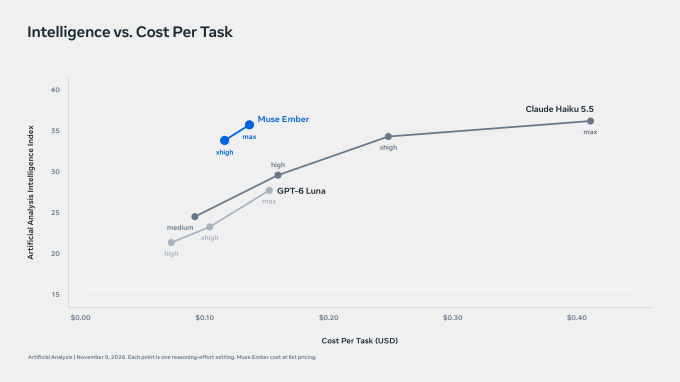
Meta Superintelligence Labs has released Muse Ember, a new model designed for the repetitive execution work inside AI agents. TechCrunch reports that Meta calls Ember its lightest and most cost-efficient AI model so far. The model is aimed at tool calls, coding subtasks, routing, information extraction and parsing long documents rather than at the broadest possible reasoning tasks.
The economic claim is central to the release. Meta lists an input price of 10 cents per million tokens, which puts Ember well below the prices cited for larger frontier models. TechCrunch also reports that Meta used Artificial Analysis’s composite benchmark to present Ember as cheaper and more capable than several competitors, including Anthropic’s Haiku and OpenAI’s Luna. Those comparisons are useful context, but they are benchmark and pricing snapshots, not an independent guarantee for every production workload.
Meta’s intended architecture is a division of labour between models. A larger model such as Muse Wonder could establish a plan or decide how a task should be handled, while Ember carries out many similar steps at lower cost. In a customer-support example, the heavier model might set the rules and Ember could apply them across a large volume of cases. Meta summarises that idea as: Muse Wonder plans, Muse Ember handles the volume.
Ember is also described as multimodal. It can work with text, images and audio, so an agent could process a screenshot, chart, scanned document, voice memo, meeting recording or video without routing each input to a separate model. That may simplify agent pipelines, although the announcement does not establish how well Ember performs on every medium or how much context each task can handle.
The release is the fourth model under Meta’s Muse brand, following Spark, the open-source Glimmer and the larger Wonder model, according to TechCrunch. For AI makers and businesses, the important signal is that agent economics are becoming a model-design target in their own right. Lower per-task cost can make background automation more practical, but the real calculation still includes failed tool calls, retries, latency, monitoring and human review. Ember is therefore best understood as a component for high-volume agent workflows, not as a universal replacement for larger models.