MIT researchers use AI to edit Qwen model weights
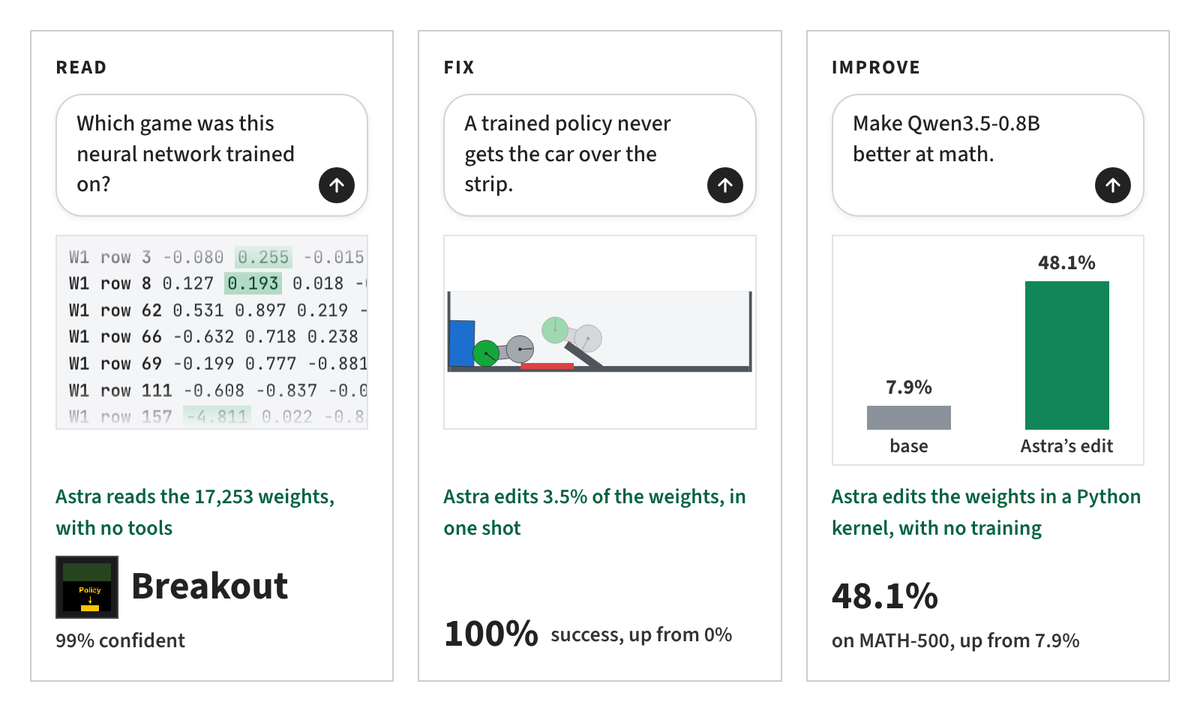
Researchers at MIT CSAIL reported on 2 November 2026 that an AI model can inspect and directly alter the numerical weights of other neural networks. In their most practical example, OpenAI's GPT-6 Astra modified a small Qwen model without gradient-based retraining, substantially improving its performance on mathematics and instruction-following tests.
The researchers call the approach Weight-Space Programming. Weights are the numbers that determine how a neural network processes information. Conventional training adjusts them through an optimization procedure. Here, Astra reasoned about the model's behavior and used a Python environment to make targeted edits. It could test practice problems, but the final evaluation sets were withheld.
For Qwen3.5-0.8B, Astra changed 131,072 weights, approximately 0.016% of the model. With a budget of 50 batches of practice evaluations, the authors report that its MATH-500 score rose from 7.9% to 48.1%. Instruction-following performance on IFEval increased from 21.0% to 62.3%. These figures come from the researchers' own experimental protocol.
The improvement has a specific explanation. The original Qwen model frequently repeated its reasoning until it exhausted its response limit. Astra identified and weakened a direction in two layers associated with that looping. On MATH-500, the share of answers reaching the limit fell from 93.0% to 33.1%. The intervention helped existing abilities produce finished answers.
The limits matter just as much. A separate attempt to improve Gemma 3 270M, which rarely looped, produced no established improvement. The results therefore do not demonstrate a general way to add missing mathematical knowledge or to make frontier systems improve themselves. The authors describe their work as early research.
The team published experiment logs on GitHub and an edited checkpoint on Hugging Face. The checkpoint's model card reports a further MATH-500 run scoring 51.0%, credited to Hugging Face's Ahsen Khaliq. That checks a released model under a stated protocol; it does not establish that the editing method will work across architectures.
For developers, the research suggests a possible route to diagnosing and repairing specific model failures. Its immediate value is an inspectable experiment, with weights and evaluation records available for scrutiny. Broader use will depend on reproducibility, side-effect testing and evidence that targeted repairs remain reliable beyond a particular benchmark.