Quantization-aware healing makes a compressed 4-bit model outperform its source
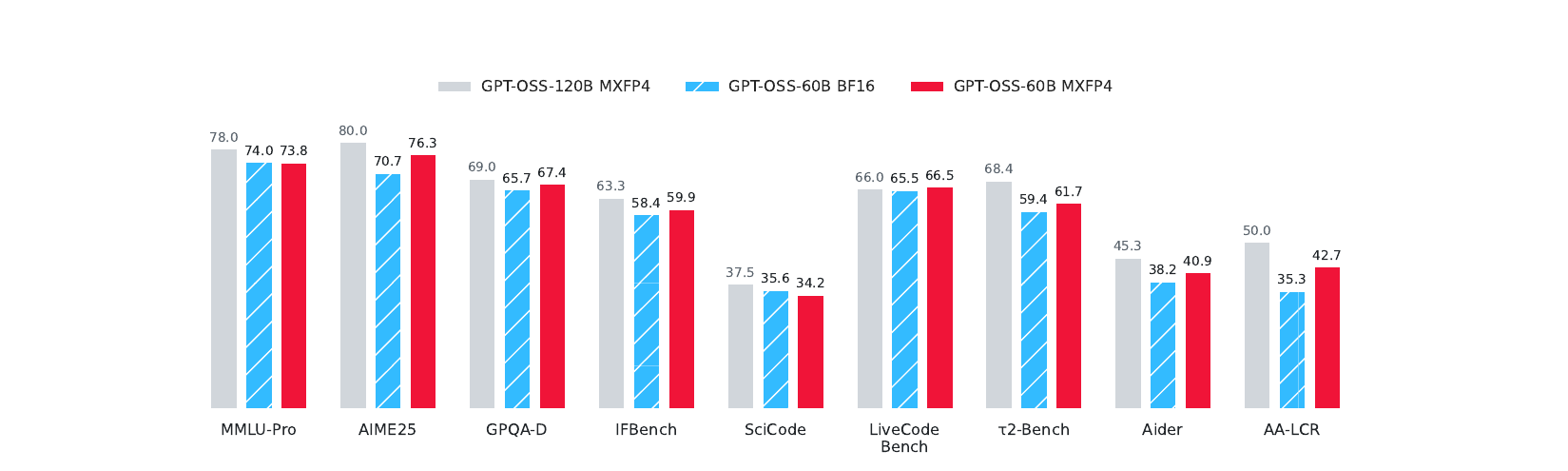
Multiverse Computing has published a method for recovering an AI model after two kinds of compression: reducing its architecture and lowering the precision of its weights. In a Hugging Face article dated August 25, 2026, the company presents Quantization-Aware Healing, or QAH, and applies it to a GPT-OSS 120B model that was compressed to 60B parameters and quantized to MXFP4, a 4-bit format.
The comparison is with the best full-precision version of that smaller architecture, a 60B model in bfloat16. According to Multiverse Computing, the QAH model matched or exceeded that bfloat16 checkpoint on seven of nine benchmarks. It scored 42.7 versus 35.3 on AA-LCR for long-context reasoning, 76.3 versus 70.7 on AIME 2025 mathematics, and 40.9 versus 38.2 on Aider agentic coding. It trailed on MMLU-Pro and SciCode by 0.2 and 1.4 points respectively. These are the company’s reported results, not an independent evaluation.
The central change is where the training signal comes from. Conventional quantization-aware training uses task loss with fake quantization, while distillation can teach a quantized model to imitate a full-precision version of the same architecture. After structural compression, however, that exact teacher does not exist. QAH instead distills the original, full-size model directly into the smaller 4-bit student using the teacher’s output distribution and a KL-divergence loss. The two models therefore need not share an architecture.
Multiverse Computing also reports a matched comparison on a GPT-OSS 9B model. QAH reached a similar peak to quantization-aware training, but did so in about 100 steps rather than 700 and remained stable. The QAT run later lost nearly 19 points by step 1,200, according to the article.
For people deploying models, the practical appeal is lower resource use without assuming an automatic accuracy penalty. The QAH model has half the parameters of its teacher and uses roughly four times less weight memory than its bfloat16 counterpart. That may make capable models easier to run on smaller hardware. The findings still need reproduction across models and tasks, but they suggest that quantization can be part of a second learning phase rather than only a lossy final conversion.